Astana city, Esil district, Dinmuhamed Konaev street, 25/1. enquiry@karabau.kz +7 707 456 7413

Product range

Products

Karabau Petroleum produces a wide range of oil products: motor petrol of various brands, diesel fuel, oil fuel (mazout), hydrocarbon liquefied gases, vacuum gas oil, technical sulfur, bitumen of several grades and petroleum coke.

Product 01

Motor Gasoline

The main production processes of high-octane components of motor gasoline are catalytic reforming of straight-run gasoline fraction from the complex of primary oil processing and catalytic cracking of heavy oil fractions (vacuum gas oil). Since 2020 the factory has started to produce unleaded gasoline.

Gasoline produced by Karabau Petroleum LLP has improved ecological properties; it is delivered in many regions of Kazakhstan and greatly appreciated by consumers.

Grades produced

  • AI-80NUndyed motor gasoline
  • AI-92NUndyed motor gasoline
  • AI-95NUndyed motor gasoline
  • AI-98NUndyed motor gasoline

Produced according to ST of JSC 39334881-001-2006.

Modern fuel dispensers at a petrol station forecourt
Unleaded: Karabau Petroleum LLP has completely refused the application of ethyl fluid. There are almost no highly toxic lead compounds in motor gasoline.

Quality characteristics of motor gasoline

Gasoline is intended for application in reciprocating internal combustion engines with positive ignition (from a spark). It is characterized by quality characteristics which determine their physical, chemical and operational properties: antiknock rating (octane number); breakdown time; lead concentration, sulphur content; saturated vapour pressure.

Antiknock rating (octane number)

Antiknock rating is a parameter which characterizes an ability of motor gasoline to resist self-ignition under compression. The high antiknock rating of fuel provides its normal combustion in all operating conditions of the engine. Antiknock value of motor gasoline is the octane number showing the isooctane content in the mixture with n-heptane that is equivalent on antiknock rating to fuel tested in standard conditions.

The octane level is defined by two methods: motor (MM) and research (RM) one with different conditions of gasoline testing. The octane level defined by motor method characterizes antiknock rating of fuel by car operation in the enhanced heating accelerated conditions; the octane number defined by research method characterizes gasoline by operating on partial loads in the conditions of urban driving.

Chemical stability — breakdown time

Chemical stability of commercial gasoline is characterized by breakdown time — the time from the beginning of test until the beginning of oxidation process. The longer the breakdown time, the higher gasoline stability to the oxidation is on long storage. The gasoline characterized by breakdown time of not less than 900 min. can keep the properties during the guaranteed storage life (5 years).

Motor gasoline should be chemically neutral and non-corroding. Corrosivity of gasoline and residues of its combustion depends on the content of the total and mercaptan sulphur, acidity, content of water-soluble acids and alkalis, and water.


Ecological parameters — lead compounds

Among ecological parameters of gasoline the major one is the content of lead compounds. In this connection Karabau Petroleum LLP has completely refused the application of ethyl fluid. There are almost no highly toxic lead compounds in motor gasoline.

Saturated vapour pressure and fractional composition

Saturated vapour pressure and fractional composition define startability of gasoline, its tendency to vapour lock formation, physical stability. Startability of gasoline deteriorates with decline of its saturated vapour pressure. At pressure of 34 kPa the vapour concentration of gasoline in the working area is so small that the engine start becomes impossible.

Product 02

Diesel Fuel

Diesel fuel is mostly produced by mixing of the straight-run component from the complex of primary oil processing with diesel fuel passed through hydrotreating for the purpose of decrease in the content of sulphurous, nitrogenous, oxygenated, metalorganic compounds.

Stable operation of engines and reduction of the specific fuel consumption is provided by using diesel fuel of summer and winter grades. Karabau Petroleum LLP has mastered the production of diesel fuel with the low pour point which provides the possibility to operate machinery in severe winter conditions.

It is used in Diesel engines and some types of gas-turbine engines. High compression ratio is achieved in Diesel engine, owing to what the specific fuel consumption in it is lower by 25-30% than in carburettor engine.

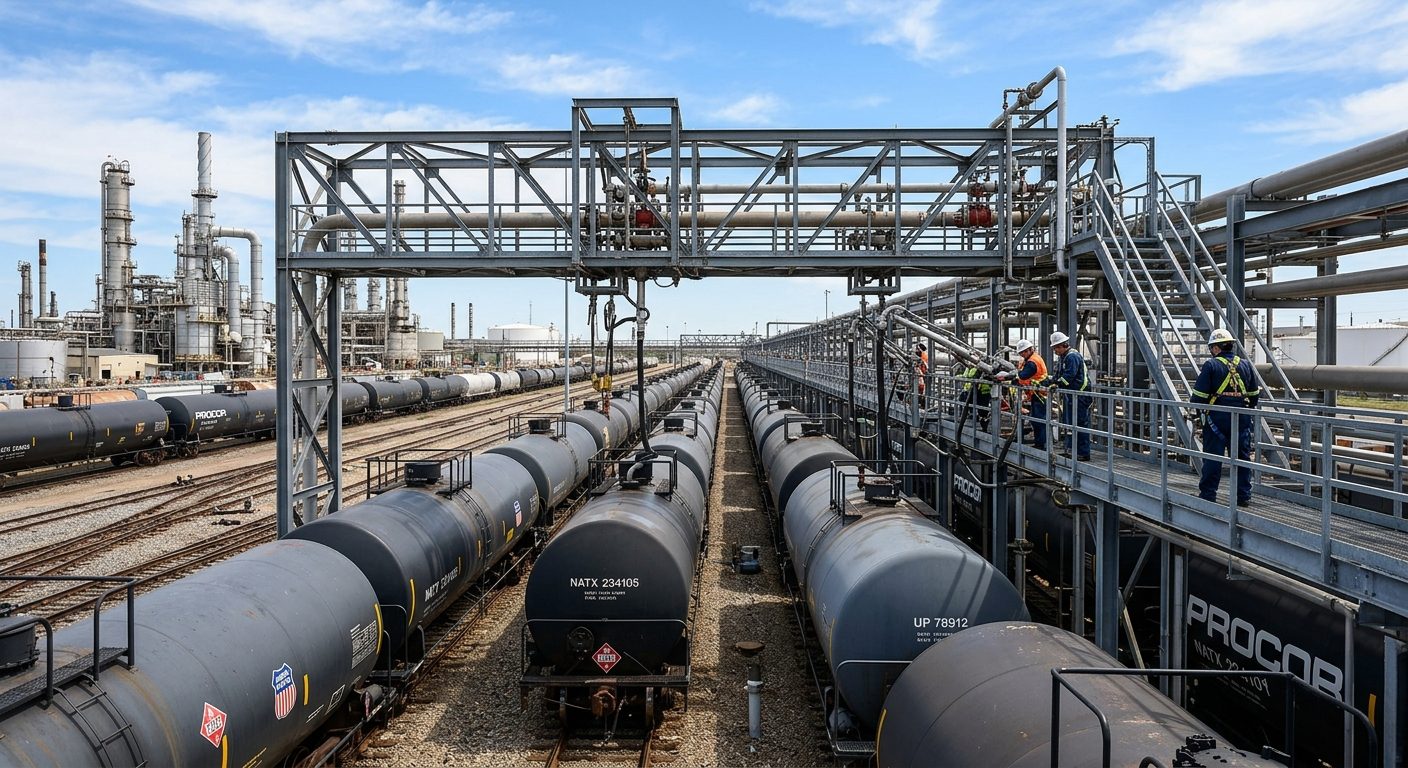
Railway tank cars being loaded with petroleum products at the refinery loading rack DispatchRail and road loading racks

Basic quality characteristics of diesel fuel

The basic quality characteristics of diesel fuel are: flammability (cetane number); fractional composition; viscosity and density; flash point; low-temperature properties.

Flammability — cetane number

Cetane number is a basic parameter of flammability of diesel fuel. It defines the engine start, roughness of working process (rate of pressure rise), fuel consumption and exhaust smoking. The higher cetane number of fuel, the less the rate of pressure rise is and the less rough the engine works. The higher cetane number of fuel, the faster the process of its preliminary oxidation in the combustion chamber, the faster the mixture of fuel will be ignited and the engine will be started.

Fractional composition

Fractional composition is a parameter that influences the character of fuel combustion. For combustion of fuel with lighter fractional composition less air is used, thus time for fuel and air mixing decreases, and carburetion processes proceed more completely.

Viscosity and density

Viscosity and density define evaporating and mixing processes in the injection engine, as the shape and the structure of flame, size of formed drops, range of penetration of fuel drops into the combustion chamber depend on these properties. Lower viscosity and density provide better fuel atomization; by raising of these parameters diameter of drops increases and their full combustion decreases, as a result the specific fuel combustion and the exhaust smoking increase. Deterioration of pair of hydraulic pistons depends on viscosity as well.

Flash point

Flash point defines fire danger of fuel. According to GOST 305-82 fuel is produced with flash point of min. 40°C for Diesel engines of general purpose and min. 62°C for diesel locomotive and ship engines.

Low-temperature properties

Low-temperature properties are characterized by such parameters as cloud point and pour point. For many grades of diesel fuel the difference between these two points makes 5-7°C.

By producing diesel fuel with the low pour point the parameter "Cloud point or cold filter plugging point" is additionally controlled.

Diesel fuel grades produced by Karabau Petroleum LLP

Grades by specification
Specification Grade designations
According to GOST 305-82 L-0,2-40   L-0,2-62
According to ST of JSC 39334881-003-2006 PZ-0,2 minus 30   PZ-0,2 minus 25   PZ-0,05 minus 30   PZ-0,05 minus 25
L-0,2-40   L-0,2-62   L-0,05-40   0,05-62

Further products

Other refined products from the Karabau complex

Alongside motor gasoline and diesel fuel, the refinery produces a range of intermediate and heavy products for industry, construction and transport.

Oil Fuel (Mazout)

Residual fuel oil obtained through the Complex of Crude Oil Advanced Processing. Mazout is used as a fuel for heat and power generation in industrial and utility installations, and is also a feedstock for deep conversion in the fuel complex KT-1.

Residual fuelIndustrial

Hydrocarbon Liquefied Gases

Liquefied hydrocarbon gases produced by the refinery and stored in a dedicated liquefied gases tank farm. Dispatched to consumers by rail and road transport using the refinery's loading and unloading racks.

LPGTank farm

Vacuum Gas Oil

A heavy distillate fraction taken from vacuum distillation. It is used as feedstock for catalytic cracking to produce high-octane gasoline components, and as a component in blending.

Heavy distillateFeedstock

Technical Sulfur

By-product sulfur recovered from process gas streams in the Complex of Sulfur Recovery Units. The Sulfur Granulation Unit converts it into granulated technical sulfur for safe handling, storage and transport.

GranulatedRecovery units

Bitumen of Several Grades

Produced in the Bitumen Production Unit of the Complex of Heavy Oil Residue Processing. The refinery produces bitumen of several grades for construction, road building and roofing applications.

ConstructionRoadRoofing

Petroleum Coke

Produced in the Delayed Coking Unit within the Complex of Heavy Oil Residue Processing and further processed in the Coke Calcination Unit. Petroleum coke serves as a carbon feedstock for metallurgy and industry.

CalcinedCarbon feedstock
Central Refinery Laboratory analyst testing a fuel sample Central Refinery LaboratoryEvery batch verified before dispatch

Quality assurance

Central Refinery Laboratory

Quality control across the refinery is carried out by the Central Refinery Laboratory (CRL) — one of the large auxiliary units of the enterprise. The laboratory monitors raw materials, intermediate process streams and finished commercial products against the requirements of the applicable specifications:

  • Motor gasoline to ST of JSC 39334881-001-2006 — grades AI-80N, AI-92N, AI-95N, AI-98N.
  • Diesel fuel to GOST 305-82 and ST of JSC 39334881-003-2006.
  • K-4 motor fuels to the Technical Regulations of the Customs Union.
  • Cold-flow properties of winter diesel, including cloud point and cold filter plugging point.

Commercial enquiries

Request grades, volumes and delivery terms

Tell us which products you need and the volumes required, and our commercial team will come back to you with availability and logistics options.